Combinatorics and Probability Theory
This session explores the principles of counting and the foundations of probability theory.
We work with the multiplication rule, permutations and combinations, and classical probability of events.
We also introduce conditional probability and non-trivial applications that illustrate the depth of these concepts.
Session Preparation:
Brooks: Chapter 4
Resources Danish Class:
Recap Exercises
Recap Exercise 1: Is this a set?
Which of the following are sets?
-
\(\{3\}\) (1)
- Yes
-
\(\{3,5,1,03\}\) (1)
- Yes
-
\(\{\text{NULL}, \text{apple}, 5, B\}\)(1)
- Yes
-
\(\{1,2,\text{NULL},4,5,\text{NULL},3\}\)(1)
- No, duplicates
-
\(\{\text{David}, \text{Roger}, \text{Nik}, \text{Richard}\}\)(1)
- Yes
-
\(\{\text{Michael}, \text{John}, \text{Terry}, \text{Eric}, \text{Graham}, \text{Terry}\}\)(1)
- No, duplicates
Recap Exercise 2: Dual Isomorphism
Show that \((A \cup B) \setminus B = A \setminus B\) using a truth table.
| A | B | B\(^c\) | A ∪ B | (A ∪ B) ∧ B\(^c\) | A ∧ B\(^c\) |
|---|---|---|---|---|---|
| 0 | 0 | 1 | 0 | 0 | 0 |
| 0 | 1 | 0 | 1 | 0 | 0 |
| 1 | 0 | 1 | 1 | 1 | 1 |
| 1 | 1 | 0 | 1 | 0 | 0 |
The columns for \((A \cup B)\cap B^c\) and \(A\cap B^c\) are identical.
Recap Exercise 3: Set Identities
Show that \((A \oplus B)\cap A = A \setminus B\) using set identities.
Recap Exercise 4: Number of Elements
Set \(A\) has \(100\) elements, set \(B\) has \(50\) elements.
-
If \(A \cap B\) has \(25\) elements, how many elements does \(A \cup B\) have?
\(|A \cup B| = |A| + |B| - |A \cap B| = 100 + 50 - 25 = 125\)
-
If \(A \cup B\) has \(125\) elements, how many elements does \(A \cap B\) have?
\(|A \cap B| = |A| + |B| - |A \cup B| = 100 + 50 - 125 = 25\)
Normal exercises
Exercise 1: Combinatorics and Probability
An order for a personal digital assistant can specify any one of five memory sizes, any one of three types of displays, any one of four sizes of a hard disk, and can either include or not include a pen tablet. How many different systems can be ordered? State which Rule/Theorem from the book that you use.
\(5 \cdot 3 \cdot 4 \cdot 2=120\) (Multiplication Rule)
Exercise 2: Garage Doors and Burglars
A wireless garage door opener has a code determined by the up or down setting of 12 switches.
-
How many possible codes are there?
\(2^{12} = 4096\)
-
What is the probability that a burglar guesses the right code in the first try?
\(\frac{1}{4096} = 0.000244 = 0.0244\%\)
Exercise 3: Combinatorics and Probability
A group of 3 kids is to be formed in a class of 15 kids.
-
In how many different ways can you make the group if the order of the kids doesn't matter?
\(\binom{15}{3} = 455\)
-
In how many different ways can you make the group if the order of the kids does matter?
\(P(15,3)=\frac{15!}{12!}=2730\)
-
What is the probability that the group will consist of the three kids Xavier, Ygritte and Zelda?
\(\frac{1}{455}=\frac{6}{2730}=0.00220 = 0.220\%\)
Exercise 4: Poker Hands
In how many ways can you deal a poker hand of five cards from a standard deck of 52 cards? Also, how many ways are there to select 47 cards from a standard deck of 52 cards?
\(\binom{52}{5}=2,598,960\)
\(\binom{52}{47}=2,598,960\)
Exercise 5: Garage Doors and Burglars Revisited
Recall the garage doors from Exercise 2. What is the probability that a burglar guesses the right code in 3 tries, assuming that the guesses happen with replacement?
\(1-\left(\frac{4095}{4096}\right)^3 \approx 0.00073\)
Exercise 6: Webpage Passwords
A webpage requires the user to create a password that contains exactly 4 characters.
Let \(A\) denote the set of passwords containing only letters (there are 26 lowercase letters, a-z, and 26 uppercase letters, A-Z).
Let \(B\) denote the set of passwords containing only numbers (0-9).
Let \(C\) denote the set of passwords that can contain both letters and numbers. A hacker tries to guess the password of a particular user.
What is the probability that he guesses the correct password in the first attempt in each of the cases below?
-
If only \(A\) is allowed:
\(\frac{1}{52^4}= \frac{1}{7,311,616}\)
-
If only \(B\) is allowed:
\(\frac{1}{10^4}= \frac{1}{10,000}\)
-
If only \(A \cup B\) is allowed:
\(\frac{1}{52^4+10^4}= \frac{1}{7,321,616}\)
-
If \(C\) is allowed:
\(\frac{1}{62^4}= \frac{1}{14,776,336}\)
Exercise 7: Probability
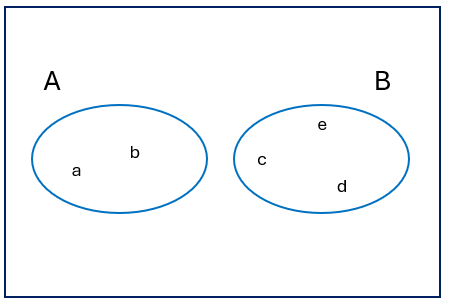
The possible five outcomes of a random experiment are equally likely. The sample space is \(\{a,b,c,d,e\}\). Let \(A=\{a,b\}\) and \(B=\{c,d,e\}\).
-
Draw a Venn diagram showing the sample space and each of the events \(A\) and \(B\).
-
Determine each of the following probabilities:
\(P(A)\)
\(P(A)=\frac{2}{5}\)
\(P(B)\)
\(P(B)=\frac{3}{5}\)
\(P(\overline{A})\)
\(P(\overline{A})=\frac{3}{5}\)
\(P(A \cup B)\)
\(P(A \cup B)=1\)
\(P(A \cap B)\)
\(P(A \cap B)=0\)
Challenge Exercises
Challenge Exercise 1: Passwords
A computer password consists of 4 characters, each one of 26 lowercase letters or 26 uppercase letters or an integer between 0 and 9. If the password must contain at least one letter and at least one integer, how many different passwords are possible?
The easiest way to calculate this, is to first calculate the number of 4-character passwords, and then subtract those that do not fulfill the rule, i.e. the passwords that do either only contain letters or only numbers: \(62^4-52^4-10^4=7,454,720\)
Challenge Exercise 2: Coupon Collector Problem
You repeatedly draw a card uniformly at random from a standard 52-card deck, with replacement.
What is the expected number of draws until you have seen all 52 distinct cards at least once?
The expected value is \(52 \cdot H_{52}\), where \(H_{n}\) is the \(n\)-th harmonic number. \(H_{52} \approx \ln(52)+\gamma+ \tfrac{1}{2\cdot 52} \approx 4.518\). Result: \(\approx 52 \cdot 4.518 = 235\) draws.
Challenge Exercise 3: Generalized Birthday Problem
How many people are needed in a room so that the probability of at least three sharing the same birthday exceeds \(0.5\) (assume 365 equally likely birthdays, ignore leap years)?
Using Poisson approximation: expected number of triples \(\approx \frac{n^3}{6\cdot 365^2}\). Solve \(\frac{n^3}{6\cdot 365^2} \approx \ln 2 \approx 0.693\). \(n \approx (0.693 \cdot 6 \cdot 365^2)^{1/3} \approx 88\). So around 88 people are required.
Challenge Exercise 4: Conditional Probability with Urns
An urn contains 5 red balls and 7 blue balls. You draw two balls without replacement.
-
What is the probability the two balls are of the same color?
\(P(\text{same})=\frac{\binom{5}{2}+\binom{7}{2}}{\binom{12}{2}}=\frac{10+21}{66}=\frac{31}{66}\approx 0.47\)
-
Suppose you draw one ball (not revealing its color), then return it, then draw again. What is the probability both are the same color?
With replacement: \(P(\text{same})=\left(\tfrac{5}{12}\right)^2+\left(\tfrac{7}{12}\right)^2=\tfrac{25+49}{144}=\tfrac{74}{144}=\tfrac{37}{72}\approx 0.51\)
-
Explain the difference between the two scenarios.
Without replacement introduces dependence (fewer balls left), lowering the chance of a match. With replacement, draws are independent, giving a slightly higher probability.