Functions
Work through these tutorials after watching the Functions videos. Each subsection walks through the main ideas step by step with worked examples. The exercises on the topic page use different problems — they are not copies of the tutorial or video examples.
1. Functions and graphs
A function takes an input and returns exactly one output. We often write the input as \(x\) and the output as \(y = f(x)\).
| Term | Meaning |
|---|---|
| Domain | All input values \(x\) for which the function is defined |
| Range | All possible output values \(f(x)\) |
Key property: one input cannot give two different outputs. Different inputs may give the same output.
A function can be represented by a formula, a table, a graph, or a word description. In calculations we usually prefer a formula.
Function notation
In \(f(x) = 2x + 3\):
- \(f\) is the name of the function
- \(x\) is the variable (input)
- \(f(x)\) is the output value when the input is \(x\)
Worked example — evaluate: Find \(f(5)\) when \(f(x) = 2x + 3\).
Substitute \(x = 5\): \(f(5) = 2(5) + 3 = 13\).
Worked example — solve: If \(f(x) = 5\) and \(f(x) = 2x + 3\), find \(x\).
Here \(5\) is an output, not “\(x = 5\)”. Solve:
Worked example — domain and range: For \(f(x) = \sqrt{2x}\), find the domain and range.
- \(\sqrt{2x}\) requires \(2x \ge 0\), so domain is \([0, \infty)\).
- Square roots are non-negative, so range is \([0, \infty)\).
Worked example — reading a graph: The graph of \(f(x) = \sqrt{2x}\) passes through \((8, 4)\).
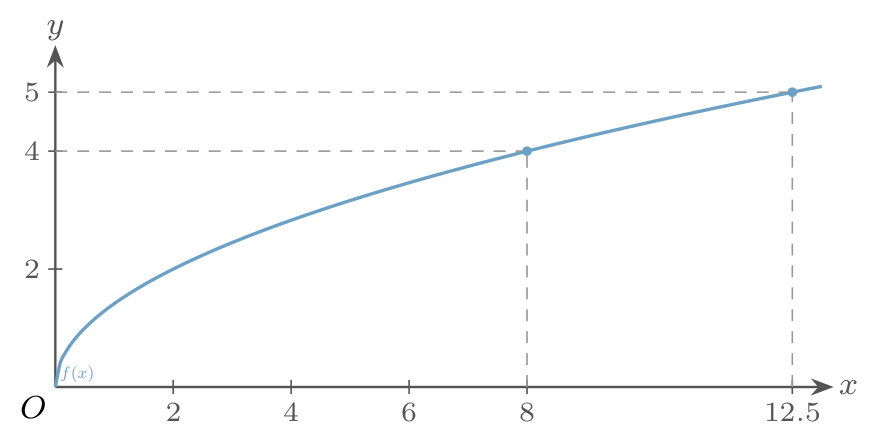
That means \(f(8) = 4\).
To find the input when the output is \(5\), use the graph (or solve \(\sqrt{2x} = 5\)):
So when \(f(x) = 5\), the input is \(12.5\).
Check your understanding
Try Exercise 1 and Exercise 5 on the topic page.
2. Common function types
Linear functions
- \(a\) is the slope (rate of change)
- \(b\) is the \(y\)-intercept
Linear growth has a constant rate of change: increasing \(x\) by 1 always changes \(y\) by \(a\).
Worked example: From the graph of a line with slope \(2\) and \(y\)-intercept \(-1\), write the formula.
Power functions
- \(b = f(1)\) (value at \(x = 1\))
- The exponent \(a\) controls shape:
- \(a < 0\): decreasing
- \(0 < a < 1\): increasing, but flattening
- \(a > 1\): increasing, getting steeper
For power functions, a percentage change in \(x\) leads to a predictable percentage change in \(y\) (multiply \(x\) by \(k\), multiply \(y\) by \(k^a\)).
Worked example: Three power functions all pass through \((1, 2)\), so \(b = 2\) for each. Examples include \(f(x) = 2x^{-1}\), \(f(x) = 2x^{0.5}\), and \(f(x) = 2x^2\) — same \(b\), different \(a\).
Exponential functions
- \(b\) is the initial value (\(f(0) = b\))
- \(a\) is the growth factor
- \(0 < a < 1\): decreasing (each step multiplies by \(a\))
- \(a > 1\): increasing
Worked example: \(f(x) = 2 \cdot 0.4^x\) has \(b = 2\) and \(a = 0.4\). Each time \(x\) increases by 1, the value is multiplied by \(0.4\) (a decrease of 60%).
Worked example: \(f(x) = 2 \cdot 1.6^x\) has \(b = 2\) and \(a = 1.6\). Each time \(x\) increases by 1, the value increases by 60%.
Exponential functions have a rate of change proportional to the current value — the graph gets steeper as \(y\) grows.
Check your understanding
Try Exercises 2 and 3 on the topic page.
3. Inverse functions
The inverse function \(f^{-1}\) reverses \(f\): if \(f(x) = y\), then \(f^{-1}(y) = x\).
An inverse exists only when \(f\) is one-to-one (each output comes from exactly one input). Use the horizontal line test: if some horizontal line hits the graph more than once, there is no inverse on that domain.
Example: \(f(x) = x^2\) is not one-to-one on all real numbers (both \(2\) and \(-2\) give output \(4\)). Restricting to \(x \ge 0\) allows \(\sqrt{x}\) as the inverse.
Finding an inverse algebraically
- Write \(y = f(x)\)
- Swap \(x\) and \(y\)
- Solve for \(y\)
- Write the result as \(f^{-1}(x)\)
Worked example: Find the inverse of \(g(x) = 3x + 2\).
- \(y = 3x + 2\)
- Swap: \(x = 3y + 2\)
- Solve: \(y = \dfrac{x - 2}{3}\)
- So \(g^{-1}(x) = \dfrac{x - 2}{3}\)
The graphs of \(f\) and \(f^{-1}\) are reflections of each other in the line \(y = x\).
Logarithms as inverses of exponentials
If \(f(x) = 10^x\), then \(f^{-1}(x) = \log_{10}(x)\).
| \(x\) | \(10^x\) | \(\log_{10}(x)\) |
|---|---|---|
| 0 | 1 | — |
| 1 | 10 | 0 |
| 2 | 100 | 1 |
| 3 | 1000 | 2 |
So \(\log_{10}(1000) = 3\) because \(10^3 = 1000\).
Similarly, \(f(x) = e^x\) has inverse \(f^{-1}(x) = \ln(x)\) (natural logarithm), where \(e \approx 2.718\).
Useful facts:
- \(e^0 = 1\), so \(\ln(1) = 0\)
- \(\ln(x)\) is defined only for \(x > 0\) (you cannot take \(\ln(0)\))
Worked example: Simplify \(\log_{10}(10^x)\).
Since \(\log_{10}\) undoes \(10^x\), the result is \(x\) (for \(x > 0\) in the inner exponential when working with real logarithms in applied settings).
Check your understanding
Try Exercises 6, 8, and 10 on the topic page.